
You've met with three contractors. You've sat through design presentations, answered the same questions about your style preferences, and finally received your quotations. Now you're staring at a stack of PDFs, each one formatted differently, priced differently, and promising more or less the same thing. One is RM45,000. Another is RM72,000. The third is RM38,000.
How on earth do you compare them?
Reading a renovation quotation is a skill most Malaysian homeowners never learn until they've already made an expensive mistake. This guide will change that. Whether you're renovating a KL condo, a Selangor terrace house, or a semi-detached in Petaling Jaya, here's exactly what to look for — and what should send you running in the other direction.

What a Good Renovation Quotation Should Always Include
Before we talk about red flags, it helps to know what a proper quotation looks like. A professional renovation quote is not just a price list — it's a document that protects both you and the contractor. At minimum, it should contain the following.
1. A Detailed Scope of Works
Every item of work should be listed clearly. Not "kitchen renovation" as a single line — but individual line items such as "supply and install 18mm moisture-resistant MDF kitchen cabinet with melamine finish", "supply and lay 600mm x 600mm porcelain floor tiles", and "plumbing works for kitchen sink relocation".
The more granular, the better. Vague scopes are where disputes are born.
2. Specifications and Material Details
A good quote doesn't just say "tiles" — it says what kind of tiles, what brand or grade, what size, and what finish. Same applies to paint, cabinetry material, hardware, ceiling type, and electrical fittings. If the specifications are missing, you have no way to hold the contractor accountable when they show up with cheaper materials than you expected.
3. Unit Rates and Quantities
You should be able to see the breakdown: how many square feet of tiling, how many linear feet of cabinetry, how many light points. This allows you to cross-check the maths and compare apples to apples across multiple quotations.
4. Payment Terms and Schedule
When are payments due? Reputable contractors typically structure payments in milestones — a deposit upon signing, subsequent payments tied to specific stages of completion, and a final retention sum held until handover. The exact split varies, but a common structure is 30% deposit, then 30/30/10 across progressive stages.
5. Estimated Timeline
The quotation should state the expected duration of works and ideally when the project is expected to commence. This helps you plan ahead and gives you a basis to raise concerns if work drags on unnecessarily.
6. Warranty Terms
What is covered and for how long? Workmanship warranty for renovation works in Malaysia typically ranges from 12 to 24 months. Any contractor unwilling to commit this to paper is a concern.
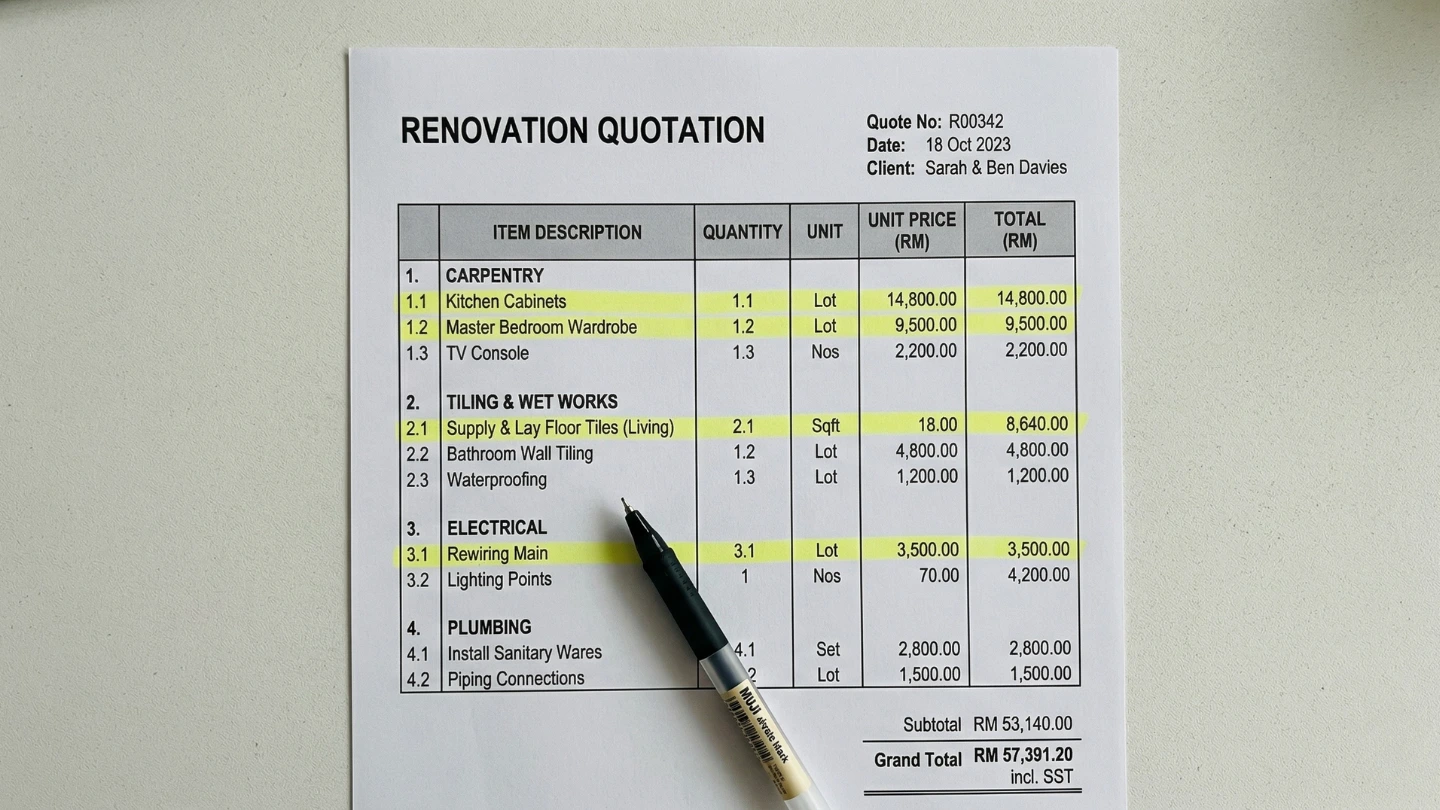
Red Flag #1: Lump-Sum Pricing With No Breakdown
This is the single most common red flag in Malaysian renovation quotations, and one of the most dangerous.
A quotation that says "Full Kitchen Renovation — RM18,000" with nothing else beneath it is not a quotation. It's a number on a page. You have no idea what's included, what materials are being used, or whether that figure covers the plumbing, the electrical, or just the carpentry.
Lump-sum pricing makes it nearly impossible to dispute changes, additions, or shortcuts taken during the project. It also makes price comparisons meaningless — you can't tell whether a RM18,000 lump sum is better or worse value than a RM22,000 itemised quote.
What to do: Ask the contractor to break it down. Any professional firm will do this without hesitation.
Red Flag #2: Suspiciously Low Pricing
We all want to save money, and a low quote is tempting. But in the renovation industry, pricing that's significantly below market rate almost always means something has been left out, or the quality of materials has been quietly downgraded.
For context, if you're getting quotes for a full terrace house renovation and one contractor comes in 40% cheaper than the rest with the same scope, that's not a bargain — that's a warning sign. Common tactics used by unscrupulous contractors include quoting for low-grade materials with the expectation of upgrading you later (at additional cost), underquoting to win the job then hitting you with variation orders once work has started, or simply cutting corners on workmanship.
What to do: When a quote is significantly lower, ask specifically what grade of materials are included. Get the answers in writing, not just verbally.
Red Flag #3: Vague or Missing Material Specifications
If the quotation lists "wall tiles" without specifying the brand, grade, size, or finish — that's a problem. You could end up with tiles that are significantly inferior to what you had in mind, and you'll have little recourse because the quote didn't promise anything specific.
This is especially important for:
- Tiles and stone: Grade A vs Grade B porcelain has a noticeable quality difference
- Cabinetry: Moisture-resistant MDF vs standard MDF matters enormously in a Malaysian kitchen, where humidity is a constant factor
- Paint: Nippon, Dulux, or house brand? Internal emulsion or washable finish?
- Plumbing fittings: Brand-name vs unbranded fittings have vastly different lifespans in tropical conditions
What to do: Request that all materials be specified by brand, grade, and model where possible. If the contractor resists, that tells you something.

Red Flag #4: Unrealistic Payment Terms
Be very wary of contractors who ask for an unusually large upfront deposit. In Malaysia, a reasonable deposit is typically 10% to 30% of the total project value. If someone is asking for 50% or more before a single tool has been picked up, proceed with extreme caution.
Large upfront payments expose you significantly if the contractor abandons the project, runs into financial trouble, or simply fails to deliver. The renovation industry in Malaysia has its share of "run road" (contractors who disappear with your deposit), and protecting yourself financially from the outset is non-negotiable.
Equally concerning are payment schedules that don't tie to milestones. If payments are due on calendar dates rather than on completion of specific stages of work, you have no leverage if work falls behind.
What to do: Insist on milestone-based payment terms, clearly defined in the contract. Each payment should be tied to a specific deliverable — for example, second payment upon completion of all structural and plumbing works, third payment upon completion of carpentry installation.
Red Flag #5: No Mention of Permits or JMB Approval
If you're renovating a condo or apartment, any legitimate contractor should be accounting for management office (JMB or MC) approval in the process. If the quotation makes no mention of this — and the contractor hasn't raised it during your discussions — either they don't understand the requirements, or they're planning to carry out works without proper approval.
Working without JMB approval in a stratified property can result in stop-work orders, fines, and in some cases, being forced to undo completed renovation works at your own cost. This is not a bureaucratic technicality — it has real financial consequences.
What to do: Ask the contractor explicitly how they handle permit and management office approvals. If they seem unfamiliar with the process, that's a red flag.
Red Flag #6: No Warranty Clause
A contractor who won't commit to a workmanship warranty in writing is a contractor who isn't confident in their own work. Full stop.
In Malaysia, a standard workmanship warranty covers defects in installation and finish — things like tiles cracking or lifting, cabinet doors misaligning, or paint peeling within a reasonable period. Twelve months is the typical minimum; reputable firms often offer 18 to 24 months.
What to do: If there's no warranty mentioned in the quotation, ask for it to be included before you sign. A contractor who refuses entirely is not a contractor worth hiring.

Red Flag #7: Verbal Promises That Aren't in the Document
This is one of the most common ways Malaysian homeowners get burned. The contractor says, "Don't worry, that's included" during the sales meeting — but when you check the quotation, it isn't there. And when a dispute arises later, you have no evidence.
The rule is simple: if it's not in the document, it doesn't exist. Upgrades, inclusions, free services, additional items — all of it needs to be written into the quotation or a formal variation order before any work begins.
What to do: After every discussion with your contractor, follow up in writing (WhatsApp is fine as documentary evidence) summarising what was agreed. And before signing, go through the quotation line by line and flag anything that was promised verbally but isn't captured.
Red Flag #8: Quotation Valid for Only a Few Days
Some contractors put a very short validity period on their quotation — sometimes as little as 3 to 5 days — as a pressure tactic to rush you into signing. While it's reasonable for quotes to have an expiry (materials prices do fluctuate), a legitimately short window designed to pressure you into a quick decision should give you pause.
A contractor who is confident in their product and pricing will give you reasonable time to review, compare, and make an informed decision. If they're rushing you, ask yourself why.
How to Compare Multiple Quotations Side by Side
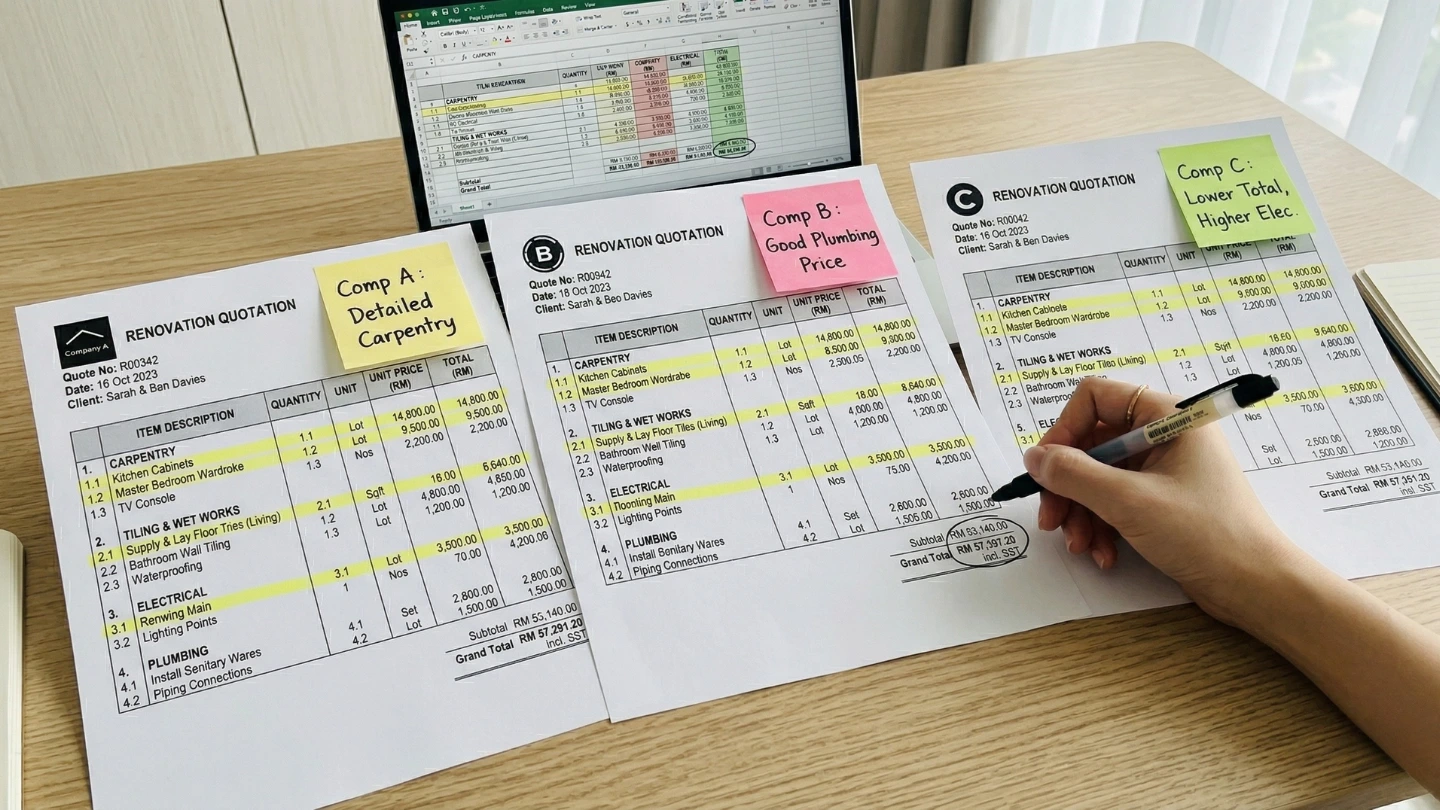
Once you have your quotations, the best approach is to create a comparison table. List all the major scope items down the left column — tiling works, carpentry, electrical, plumbing, ceiling, painting — and then map each contractor's pricing and specification across the top.
This will immediately reveal where the differences lie. One contractor might be cheaper on carpentry but significantly more expensive on tiling. Another might have included things the others didn't, which explains a higher total. Comparing this way moves you away from reacting to the headline number and towards making an informed decision about overall value.
If a contractor is unwilling to provide a detailed enough quotation for this kind of comparison, that itself tells you something about how they operate.
Before You Sign: A Quick Checklist
Run through this before committing to any contractor:
- Is the scope of works itemised in detail — no lump-sum lines?
- Are materials specified by type, brand, grade, and size?
- Are unit quantities and rates clearly shown?
- Are payment terms milestone-based, not calendar-based?
- Is the deposit reasonable (10–30%)?
- Is a project timeline stated?
- Is a workmanship warranty included?
- Are permits and approvals addressed (for condos/apartments)?
- Are all verbal promises captured in the document?
If you're ticking most of these boxes, you're in a far stronger position than the average Malaysian homeowner going into a renovation.

Final Thoughts
A renovation quotation is the foundation of your entire project. It defines what you're paying for, what quality to expect, and what recourse you have when things don't go to plan. A vague or poorly structured quotation isn't just inconvenient — it's a liability.
Take your time with it. Ask questions. If a contractor seems put out by your scrutiny, that tells you everything you need to know about how they'll handle things once your money is in their account.
And if you'd rather have a professional team handle the entire process — from scoping to execution — our interior design consultants work with homeowners across Klang Valley to deliver projects that are documented, accountable, and built to last.
Ready to start your renovation the right way? Get a free consultation with our team and we'll walk you through the entire quoting process together.